 Save
Save There was a night when I arrived at my friend's apartment with nothing but groceries and ambition, determined to prove that a grilled cheese could be sophisticated. As I stood at her stove, slowly stirring golden onions that had been cooking for what felt like forever, the smell started to shift—from raw and sharp to something almost honeyed and complex. By the time I assembled those first sandwiches with the nutty Gruyère, I understood why the French had figured this out long ago. This isn't fancy for fancy's sake; it's what happens when you give ordinary ingredients the time and attention they deserve.
I made this for my family on a Sunday afternoon when we were all tired of the usual weeknight rotation. My dad, who claims he doesn't like onions, ate two sandwiches without complaint and asked for the recipe. That moment of watching someone's mind change about a food they thought they disliked—that's when I knew this recipe had staying power.
Ingredients
- Yellow onions: Two medium ones, thinly sliced, are your foundation—and this is not the time to rush through slicing.
- Unsalted butter: Three tablespoons total (two for the onions, one softened for spreading), because butter is where the flavor comes from.
- Kosher salt and black pepper: Season the onions generously at the start; you're not being shy here.
- Sugar and balsamic vinegar: Optional but worth it—the sugar helps coax out natural sweetness, and a splash of vinegar adds complexity that makes people ask what's in this.
- Rustic sourdough or country bread: Four thick slices that can hold the weight of the caramelized onions and cheese without falling apart.
- Gruyère cheese: Five ounces grated; this is the star, so choose good quality and don't substitute unless you have to.
Tired of Takeout? 🥡
Get 10 meals you can make faster than delivery arrives. Seriously.
One email. No spam. Unsubscribe anytime.
Instructions
- Start the caramelization:
- Melt butter in a large skillet over medium-low heat, then add your sliced onions with salt and pepper. The low heat is crucial—this isn't about cooking onions quickly, it's about coaxing them into something different.
- Let time do the work:
- Stir occasionally for 25 to 30 minutes, watching as the onions gradually turn from white to pale gold to deep amber. This is the hardest part, and it requires doing nothing but patience.
- Finish with finesse:
- Stir in the sugar and balsamic vinegar if using, cook for another couple of minutes, then set aside. Your caramelized onions should look glossy and smell almost sweet.
- Build your sandwiches:
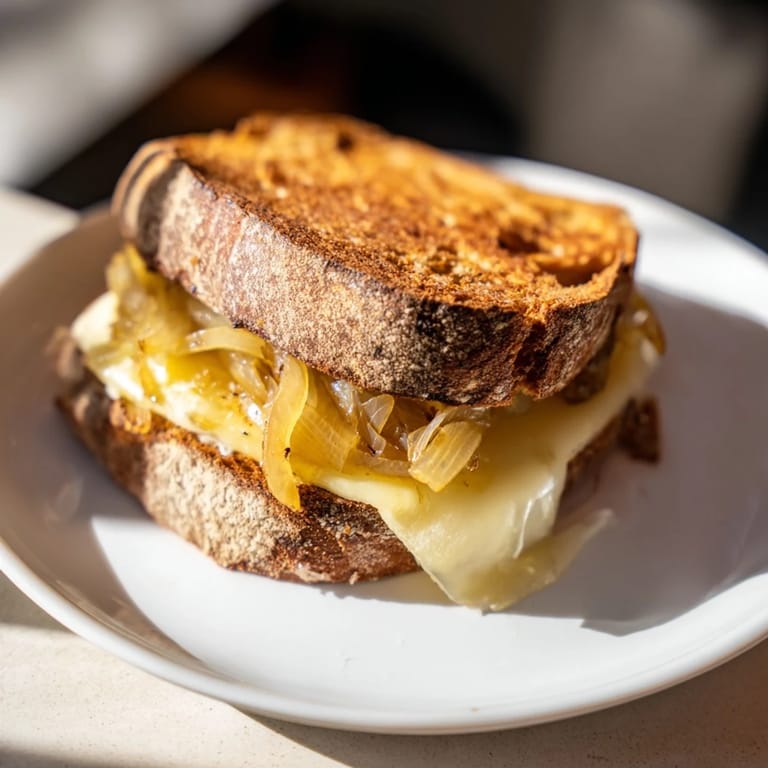
- Spread butter on one side of each bread slice, then lay two slices butter-side down on your work surface. Divide half the Gruyère between them, then distribute the caramelized onions generously, top with the remaining cheese, and close with the other slices, butter-side up.
- Cook with attention:
- Heat a nonstick skillet over medium heat, place your sandwiches in, and cook for 3 to 4 minutes per side, pressing gently. The bread should turn golden and crispy while the cheese beneath melts into the onions.
- Serve immediately:
- These are best eaten right away, while the contrast between the crispy exterior and melted interior is still alive.
 Save
Save This sandwich taught me that the most elegant dishes often come from doing one simple thing really well. There's something almost meditative about standing at the stove, stirring caramelized onions, letting the world slow down for a moment.
Why Caramelization Changes Everything
Caramelization isn't just cooking; it's a chemical transformation that breaks down onion sugars into complex, sweet compounds that taste nothing like raw onion. This is why rushed onions taste sharp and wrong, while patient ones taste rich and almost wine-like. The 25 to 30 minute investment is what separates this sandwich from every other grilled cheese you've ever made.
Cheese Matters More Than You Think
Gruyère exists in this perfect zone where it's flavorful enough to stand out but not so pungent that it overwhelms the caramelized onions. Its nutty, slightly sweet undertone complements the deep, jammy onions in a way that cheddar or American cheese simply cannot. If you can't find Gruyère, Emmental or Swiss cheese will work in a pinch, but the sandwich loses some of its sophistication.
A Few More Ideas
Once you master the basic formula, there are gentle ways to expand it without losing what makes it special. Fresh thyme stirred into the onions adds an herbal whisper that doesn't overpower anything. A few slices of good ham layered in makes it heartier for days when you need something more substantial. And if you have soup—particularly a bright tomato soup or a creamy mushroom—this sandwich becomes a complete meal that feels both comforting and refined.
- Thyme added to the onions in the last few minutes brings an earthy elegance without changing the fundamental dish.
- A side of crisp green salad cuts through the richness and keeps everything balanced.
- Make this sandwich when you have time to actually savor it, not when you're rushing out the door.
 Save
Save This sandwich has become my answer to the question of what to cook when someone needs convincing that simple food, made with intention, is worth slowing down for. It asks nothing of you except time and butter.